UV Index in Nizhny Novgorod
Current UV level, hourly chart, peak times and 5-day forecast for Nizhny Novgorod, Russia.
Now: UV 3 (Moderate) · Peak today: UV 4 at 12:00
Tomorrow: UV 2 at 13:00
 Sunrise 04:55
 Sunset 19:12
5-Day UV Forecast for Nizhny Novgorod
Daily peak UV values
16° / 4°Today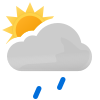 16° / 9°Fri14° / 6°Sat
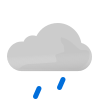 5° / 2°Sun4° / 2°Mon
Sun & Daylight Hours in Nizhny Novgorod
15:00–19:00
Seasonal daylight range at this latitude
Today, Apr 16 — Peak UV 3.6 at 12:00
Hourly UV index for Nizhny Novgorod · Local time (GMT+3)
Tomorrow, Apr 17 — Peak UV 2.3 at 13:00
Hourly UV index for Nizhny Novgorod · Local time (GMT+3)
View detailed hourly UV index
Detailed hour-by-hour UV index forecast for Nizhny Novgorod — today and tomorrow. Includes UV level, clear-sky UV, weather conditions, and temperature for each hour.
Today — Apr 16
| Hour | UV | Clear sky | Weather |
|---|---|---|---|
| 05:00 | 0.0 – Low | 0.0 | 4° |
| 06:00 | 0.2 – Low | 0.2 | 4° |
| 07:00 | 0.5 – Low | 0.5 | 5° |
| 08:00 | 1.2 – Low | 1.2 | 6° |
| 09:00 | 1.9 – Low | 1.9 | 8° |
| 10:00 | 2.8 – Moderate | 2.8 | 10° |
| 11:00 | 3.4 – Moderate | 3.4 | 12° |
| 12:00 | 3.6 – Moderate | 3.6 | 14° |
| 13:00 | 3.3 – Moderate | 3.3 | 15° |
| 14:00 | 2.7 – Moderate | 2.7 | 15° |
| 15:00 | 1.9 – Low | 1.9 | 16° |
| 16:00 | 1.1 – Low | 1.1 | 16° |
| 17:00 | 0.5 – Low | 0.5 | 15° |
| 18:00 | 0.2 – Low | 0.2 | 15° |
| 19:00 | 0.0 – Low | 0.0 | 14° |
| 20:00 | 0.0 – Low | 0.0 | 12° |
| 21:00 | 0.0 – Low | 0.0 | 11° |
Tomorrow — Apr 17
| Hour | UV | Clear sky | Weather |
|---|---|---|---|
| 05:00 | 0.0 – Low | 0.0 | 9° |
| 06:00 | 0.1 – Low | 0.2 | 9° |
| 07:00 | 0.3 – Low | 0.5 | 9° |
| 08:00 | 0.5 – Low | 1.0 | 9° |
| 09:00 | 1.4 – Low | 1.6 |  10° 10° |
| 10:00 | 2.0 – Low | 2.3 | 12° |
| 11:00 | 2.0 – Low | 2.9 | 12° |
| 12:00 | 2.3 – Low | 3.1 | 13° |
| 13:00 | 2.3 – Low | 2.9 | 14° |
| 14:00 | 2.1 – Low | 2.4 | 15° |
| 15:00 | 1.5 – Low | 1.7 | 15° |
| 16:00 | 0.8 – Low | 1.0 | 16° |
| 17:00 | 0.4 – Low | 0.5 | 15° |
| 18:00 | 0.1 – Low | 0.2 | 15° |
| 19:00 | 0.0 – Low | 0.0 | 14° |
| 20:00 | 0.0 – Low | 0.0 | 13° |
| 21:00 | 0.0 – Low | 0.0 | 12° |
About Nizhny Novgorod
Check UV in: Ivanovo · Kostroma · Dzerzhinsk
Hay fever season? Check pollen forecast in Nizhny Novgorod on Pollen.Today
About the UV Index
What is the UV index?
The UV index (UVI) is an international standard measure of the strength of ultraviolet radiation from the sun at a particular place and time. It ranges from 0 (nighttime) to 11+ (extreme). Higher values mean greater risk of sunburn, skin damage, and eye injury. The UV index was developed by the World Health Organization (WHO) to help people protect themselves from harmful UV radiation.
How do I check the UV index today?
This page shows the live UV index for your location using data from the Copernicus Atmosphere Monitoring Service (CAMS). You get the current UV level, an hourly UV forecast chart for today and tomorrow, and the exact peak UV time — so you always know when sun protection is most important.
When is UV radiation strongest?
UV radiation is typically strongest between 10:00 and 16:00, when the sun is highest in the sky. However, the exact peak time and intensity depend on your latitude, the season, altitude, cloud cover, and ozone levels. Check the UV forecast chart above to see today's exact peak time for your location.
How can I protect myself from UV radiation?
Apply broad-spectrum sunscreen, wear protective clothing and a wide-brimmed hat, seek shade during peak UV hours, and wear UV-blocking sunglasses. The WHO recommends sun protection when the UV index is 2 or above.
Where does the UV data come from?
The hourly UV index on this site comes from the Copernicus Atmosphere Monitoring Service (CAMS), operated by ECMWF on behalf of the European Union. CAMS calculates the UV biologically effective dose using total column ozone, aerosol optical depth, and cloud cover. The global forecast has a spatial resolution of approximately 45 km and provides hourly UV index values for up to 5 days ahead.
What does "clear sky UV index" mean?
The clear-sky UV index shows how strong ultraviolet radiation would be if there were no clouds at all. It is calculated using the same atmospheric data — ozone column thickness, aerosol concentrations, and solar angle — but assumes completely cloudless conditions. Comparing the actual UV index with the clear-sky value shows how much clouds are reducing UV exposure at any given time. On overcast days, actual UV can be significantly lower than the clear-sky value.
How often is the UV forecast updated?
The CAMS global UV forecast is updated twice daily, based on model runs initialized at 00:00 and 12:00 UTC. Weather data such as temperature, cloud cover, and sunrise/sunset times is updated every 1–6 hours depending on the region, using weather models from national meteorological services via Open-Meteo. The first 1–2 days of the forecast are typically the most accurate.
What does the WHO recommend for each UV level?
Source: WHO Global Solar UV Index, 2002
